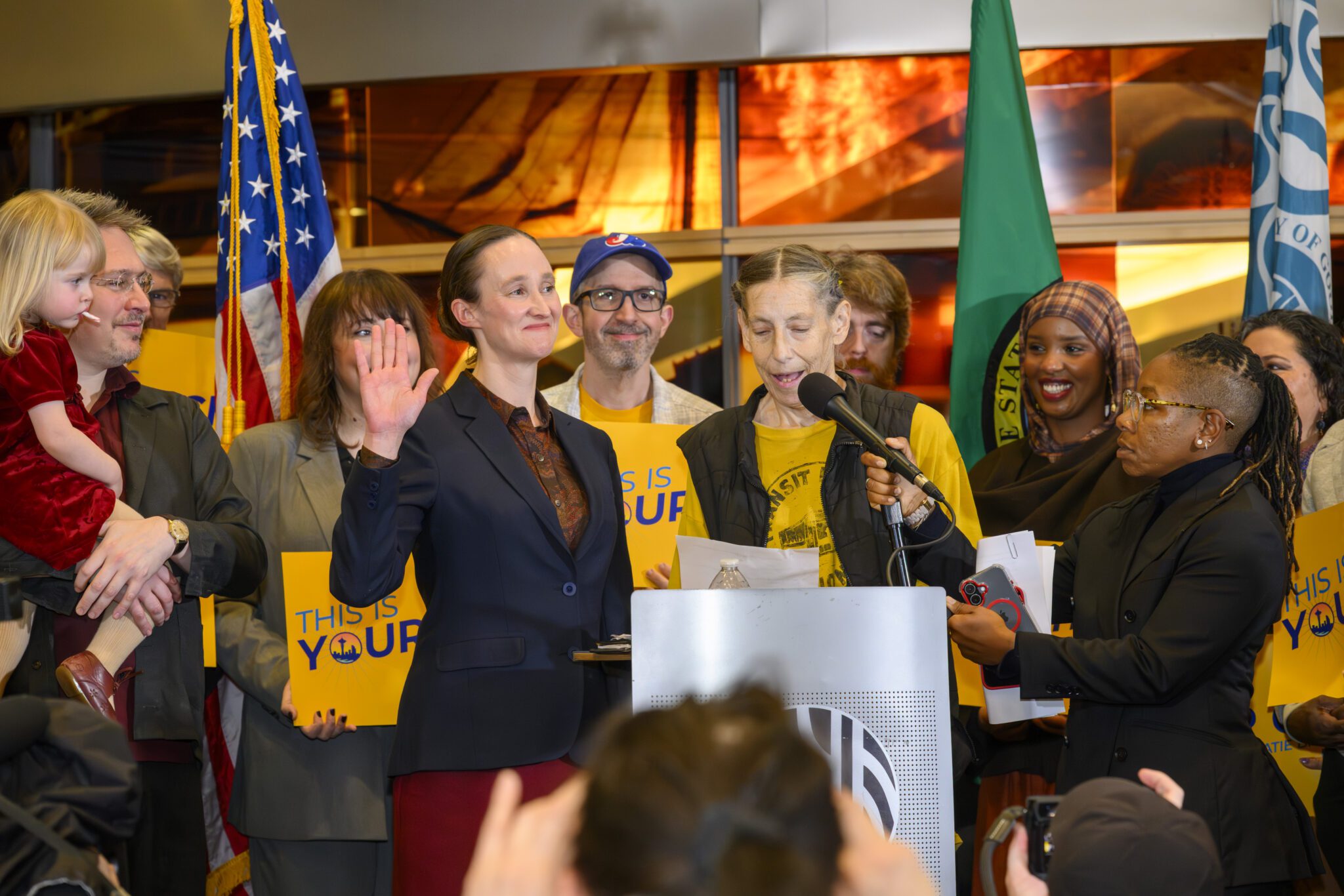
Mayor Katie B. Wilson was sworn into office on January 2, 2026. Watch the ceremony on Seattle Channel.
Remarks as written:
It is such a pleasure and an honor to be here with all of you today. I look out and I see so many people who have played a role in getting us to this place of promise and hope. I see friends and colleagues and family, I see people I’ve known for years and others I’ve met this year, and many others I don’t yet know. I see people whose names are known and celebrated, and others whose work is quiet and behind the scenes but no less important. I see fellow organizers, I see union members, I see tech workers and baristas, I see City employees. I see young people and elders, I see people whose families have lived here for generations and others who maybe just arrived to make Seattle your home.
And to all of you, and to everyone watching from afar, and to all the people who could not be here today because they are doing the hard, unsung work that makes Seattle run, I say: This is your city.
This is your city, and as your mayor, I will strive every single day to make that not just a phrase, but a living reality. This is your city — that means that you belong here, you have a right to be here and to live a dignified life, whatever your background and whatever your income. But it also means that all of us have a shared responsibility for this place, and for each other. Because Seattle is what we make of it, together.
It’s hard for me to believe that it’s been less than two months since election night. In that short space of time, a lot has happened.
For one thing, I’m getting really, really good at hiring people. (That was a joke.) But seriously, I am very excited about the team that will be joining me in the mayor’s office.
I remember conversation I had with my husband back sometime shortly after the primary, when it began to look like I might actually have a shot at becoming the mayor. We were talking about what qualities are important in hiring staff. In the end, we concluded that the most important thing was character. Someone might share my vision and my worldview, they might be competent and experienced and effective, but if they’re not in this work for the right reasons, if they don’t have enough self-awareness to reflect on their own motivations and rise above themselves when needed, then that’s not a person that I want to put in a position of power.
I believe it’s so important that the people working alongside me in the mayor’s office every day are fundamentally good people, with good judgment, who have the best interests of our city at heart. And I am filled with confidence and hope for the future in part because I know that’s going to be the case. We’re still building this team, but many of them are already on board and are here among you today, and I hope you get to meet them.
What else has happened? Late last month, I had the honor of being noticed by the president of the United States, who called me “a very, very liberal-slash-communist mayor.” It’s nice to feel seen.
And earlier this month, we launched our transition team. This team is comprised of about 60 volunteers, community leaders and experts in their fields, who are helping to turn many of the issues that I campaigned around into actionable plans and recommendations for my administration. Many of these people are also here today, and I want to say a few words about their work because I’m really proud of what they’re doing.
Sometimes mayoral transition teams can be a little bit performative. You select a bunch of people with names that other people recognize, you put them in a big room, everyone says their piece, they feel important, you feel important, and then everyone goes home. I hate that kind of thing. I don’t like wasting people’s time.
So, as a community organizer, I decided to do things a little differently. For our transition team, we chose people who were willing to roll up their sleeves, and put in real time and labor, and expand the tent. These 60 people have been hard at work, reaching out to a much wider circle of advisors across the city, building relationships and gathering information and insights. So far, in just the few weeks since we launched, they’ve collectively talked with over 700 more people.This process will continue through January, and I’m so grateful for the work of this team and excited to see the recommendations they assemble.
They’re digging into all the subjects you might expect: housing and homelessness and transportation and climate action and workers’ rights and public safety and so on. But when my transition director first shared with me a proposal for the workgroups we’d be assembling, there was one that stuck out to me: It was called “civic narrative and major initiatives.” What does that even mean?
Civic narrative. That’s the story that we tell about our city, about our collective identity, who we are and where we’re going. And major initiatives. They’re what happen when the government teams up with the people and the institutions that have access to vast amounts of capital, to put on big events or undertake big infrastructure projects that change the face of our city.
To be honest, this kind of city-making, and the civic boosterism that surrounds it, has never been my jam. I’m a rabble-rouser. I campaigned on affordability, on homelessness, on taxing the rich. I’ve spent my career organizing with the people who get left of out those official narratives.
But now I’m the mayor. It’s my job to channel excitement for major projects, and not just that, I have to genuinely care about them enough to exercise good judgment and make the best decisions possible for our city.
And so I had a little bit of a crisis of conscience: Can I do that? Can I be the mayor of the waterfront and the World Cup and the stadiums and the Seattle Center and the convention center and any other centers that we might decide to build?
Well. Good news for our city: Yes, yes I can. I’ll do it in my own way, but yes I can do that.
But it got me thinking about the idea of civic narrative and Seattle’s identity. Because the thing about cities is that there is never just one story to be told about them.
Seattle is, we all know, a city of innovation. We’re a city of software and same-day delivery and cancer immunotherapy and so much more. The kinds of advances that are powered by our tech and aerospace and biomedical industries, by our major research institutions, by the brilliance of our entrepreneurs and tech workers and engineers and researchers. That’s all a core part of Seattle’s identity.
But just as there is city-making and innovation from above, there is also city-making and innovation from below. There are kinds of innovation that no one pays you for, but they are no less important.
Because Seattle is also a city that has been home to pioneers in jazz and rock and grunge and hiphop, we’re a city of music and literature and the arts. And yes, of course you can make money in these fields, some people make a lot of money, but usually before you make any money there’s a long period of not making money. Of pursuing your calling just because you’re in love with it, because you see or hear or feel something that no one else does, and the act of creation gives your life meaning.
No one gives you venture capital to become a musician or a sculptor. Or to start a small brick-and-mortar business, to bring something new to a vacant space and enliven a neighborhood. And I can tell you from personal experience that no one pays you to start a Transit Riders Union. No one pays you to try to change the way power flows through the city, to change who has a voice in shaping the city’s future and its politics.
And these kinds of innovation from below are something I’m afraid we are at risk of losing, because it is so, so hard to afford to live in this city.
When we fight for affordable housing and childcare, it’s not just about solving the math problem of how a household can make its revenue exceed its expenses. And when we talk about reshaping our transportation system and our neighborhoods, it’s not just about making people’s commutes safer or shorter or less polluting. It’s about opening up the time and space where life happens, where people can breathe and experience and create, where we can be full human beings and not just means to an end.
I want to live in a city that honors the things you do when you’re not making money. (I’m not talking about watching Netflix.) I mean the time that you spend with your kid at the playground, caring for a sick friend or an elderly relative. I want to live in a city that celebrates the labor that people perform voluntarily, like a transit fairy who spends all day cleaning up bus stops even though no one is paying her to do it. A city that values the pursuits that create beauty and community, whether or not they ever turn into careers. A city that thinks you should have time to read a book and lay on the grass staring up at the clouds.
Because we need bread, but we need roses too. We deserve roses.
We honor this work, and leisure too, not just by praising it or saying that we value it, but by fighting to make possible a way of life where you don’t have to spend every waking moment figuring out how to pay your bills. Where you don’t have to work multiple jobs to support your kids. Where you can raise a family in an apartment because the city is your living room and the parks are your backyard and the grocery store is a short walk away.
I believe we can have all this. But it will require yet another kind of innovation: Innovation at City Hall. We are in a moment that calls for great ambition. And also, I know that the foundation of ambition is trust, and there is no more important part of my job as mayor than to build up deserved trust, your trust, in local government. That means listening and responding, solving problems, and getting results. That means making true, tangible progress on problems like homelessness, where progress has eluded our city for many years. That means paying attention to the details.
I believe that we can do all this, and we can also do big new things. We have to do big new things. And I’m going to be calling on all the brilliance and creativity and dedication of our public sector workers as we push the boundaries of what we can accomplish.
But most of all, success is going to require all of you. Is anyone here at Seattle City Hall for the very first time this morning? Welcome! This is your building. And I’m going to need you to come back here. You’re going to need to come back here again and again and again.
Because the progress we need to make, that’s not just handed down from City Hall. That’s not how power works. That’s not how power has ever worked. We wouldn’t have an 8-hour day or a minimum wage or social security without workers organizing and fighting for those things. We wouldn’t have the rights we have for women, for Black and brown people, for the LBGTQ+ community, without mass social movements fighting for dignity and equality. These things have never been given to us without people organizing and demanding change from those in positions of power.
The same is true here in Seattle. We wouldn’t have some of the strongest tenant protections in the country without renters organizing for those laws. We wouldn’t have free transit for youth if students at Rainier Beach High School hadn’t stood up and made that their fight. We wouldn’t have Jumpstart Seattle without a multi-year grassroots campaign for progressive revenue. And we wouldn’t have the highest minimum wage in the country in Tukwila and other cities around King County without people pounding the pavement and knocking on doors and getting out the vote.
With all of you is where the real power lies. And that is why I intend to govern in a way that creates space for organizers and ordinary people to do the work of pushing our city and our society forward, towards realizing our highest and best aspirations. Because I know that what I am able to accomplish in office will depend on what you’re able to build on the outside.
This is your city. And I am so proud to be your mayor. Let’s do this together.